I was standing in the frozen food aisle at the grocery store last Tuesday when it hit me — that unmistakable smell of warm, salty pretzels. It was just someone opening the freezer door a few rows over, but suddenly I was eight years old at my Aunt Peggy’s kitchen table, watching her roll dough into those perfect little knots. She’d let me sprinkle the coarse salt, and I always put too much in one spot, making a salty crater that she’d pretend not to notice. I haven’t thought about those afternoons in years. But that one random whiff in aisle seven, and I was right back there, feeling the flour on my fingers and hearing her laugh when I’d sneak a piece of raw dough.
Here’s the thing — Aunt Peggy’s pretzel rolls were incredible, but they were also a butter bomb. I mean, delicious, absolutely, but the kind of thing you’d feel for hours afterward. And honestly, I don’t eat that way anymore. I want food that feels good going down and sitting there, you know? So I started tinkering. Could I get that same chewy, golden-brown exterior, that pillowy soft center, without the heavy feeling afterwards? Turns out, yes. You can have your pretzel roll and eat it too.
These Lighter Bavarian Pretzel Rolls with Easy Mustard Butter are my answer to that grocery store memory. They’ve got all the soul of those old-fashioned rolls — the satisfying chew, the glossy brown crust, that perfect salty bite — but they’re made with a few smarter swaps that keep them feeling like an everyday treat instead of a special occasion splurge. I’ve tested this recipe maybe a dozen times, tweaking the flour ratio and the baking soda bath until it felt just right. And now, every time I pull a batch out of the oven, I think of Aunt Peggy. She’d probably tell me I’m overthinking it. But she’d also ask for the recipe.
Why You’ll Love This Recipe
I’ve made a lot of pretzel rolls in my day, and I can tell you this version is special. It’s not just another recipe you’ll bookmark and forget. These rolls deliver on flavor and texture while fitting into a more balanced way of eating. Let me break down why they work so well.
- Quick & Easy: From start to finish, these rolls take about 90 minutes. That’s mostly rising time, so you’re not stuck in the kitchen. Active prep is maybe 20 minutes.
- Simple Ingredients: No weird stuff here. Flour, yeast, water, a little milk, and baking soda. You probably have everything in your pantry right now.
- Perfect for Game Day or Cozy Dinners: These rolls work with so many meals. Serve them alongside a bowl of soup, use them for sliders, or just eat them warm with the mustard butter. No judgment.
- Crowd-Pleaser: I brought these to a potluck last month, and someone asked if I’d bought them from a bakery. That’s the kind of compliment you remember.
- Unbelievably Delicious: The texture is spot-on — crisp outside, soft inside. And the mustard butter? It’s ridiculously good. Tangy, creamy, a little sharp. You’ll want to put it on everything.
What makes these different from other pretzel roll recipes? It’s the technique. I use a combination of bread flour and whole wheat pastry flour to get that chewy texture with a lighter crumb. The baking soda bath is longer than most recipes call for, which gives you that deep brown, authentic pretzel crust. And I swap out some of the butter for Greek yogurt in the dough, which adds moisture without the extra fat. This isn’t just another version — it’s the best version I’ve landed on after weeks of testing.
Honestly, this recipe is the kind that makes you close your eyes after the first bite. It’s comfort food reimagined — lighter, faster, but with the same soul-soothing satisfaction. Perfect for impressing guests without stress, or turning a simple Tuesday dinner into something memorable.
What Ingredients You Will Need
This recipe uses simple, wholesome ingredients to deliver that classic pretzel flavor and satisfying texture without the fuss. Most of these are pantry staples, and I’ve included notes on substitutions where they work well.
For the Dough
- Bread flour, 2 cups (240g) — This gives the rolls their signature chew. I prefer King Arthur brand for consistent results.
- Whole wheat pastry flour, 1 cup (120g) — Adds a subtle nuttiness and fiber without making the rolls dense. Regular whole wheat works too, but pastry flour keeps them lighter.
- Active dry yeast, 1 packet (2 1/4 teaspoons) — Make sure your yeast is fresh. If it doesn’t foam in warm water, toss it and start over.
- Warm water, 1 cup (240ml), about 110°F — Too hot kills the yeast. Too cold and it won’t activate. Use a thermometer if you have one.
- Plain Greek yogurt, 1/4 cup (60g) — This is my secret ingredient for a tender crumb. It adds moisture and a little protein without the butter.
- Honey, 1 tablespoon — Feeds the yeast and adds a whisper of sweetness. Maple syrup works too.
- Salt, 1 teaspoon — Don’t skip this. It controls the yeast activity and builds flavor.
- Unsalted butter, melted, 1 tablespoon — Just a little for richness. You can use olive oil if you prefer.
For the Baking Soda Bath
- Water, 8 cups (2 liters) — Enough to submerge the rolls.
- Baking soda, 1/3 cup (80g) — This is what gives pretzels their dark, shiny crust. Don’t skimp here.
For the Topping
- Coarse sea salt or pretzel salt, 1 tablespoon — Use large crystals. Table salt will just dissolve and make them salty, not pretty.
- Egg wash (1 egg + 1 tablespoon water, beaten) — Gives that glossy finish. You can skip it, but the rolls won’t look as polished.
For the Mustard Butter
- Unsalted butter, softened, 4 tablespoons (56g) — Let it come to room temperature for easy mixing.
- Whole grain mustard, 2 tablespoons — I like Maille brand for the texture. Dijon works too, but the flavor is sharper.
- Honey, 1 teaspoon — Balances the mustard’s bite. Leave it out if you prefer a more savory spread.
- Salt and pepper, to taste — A pinch of each brings everything together.
Equipment Needed
You don’t need a professional bakery setup for these rolls. Here’s what I use:
- Stand mixer with dough hook — Makes kneading effortless. I’ve had my KitchenAid for ten years, and it’s still going strong. You can knead by hand, but it takes about 10 minutes of solid work.
- Large mixing bowl — For the first rise. Glass or ceramic works best.
- Kitchen scale — Not essential, but measuring flour by weight gives consistent results. I bought a $15 one on Amazon, and it’s been a game-changer.
- Large pot — For the baking soda bath. Use stainless steel or enameled cast iron. Aluminum will react with the baking soda and turn your rolls gray.
- Slotted spoon — For lifting the rolls out of the bath. A spider skimmer works even better.
- Baking sheet — Line it with parchment paper or a silicone baking mat.
- Sharp knife or lame — For scoring the tops. A razor blade works too.
- Pastry brush — For the egg wash. A silicone one is easier to clean.
Preparation Method
Let’s make some pretzel rolls. I’ve broken this down into clear steps, and I’ve included all the little details I wish someone had told me when I first started making these.
- Activate the yeast. In the bowl of your stand mixer, combine the warm water (110°F is ideal — warm but not hot on your wrist) and honey. Sprinkle the yeast over the top and let it sit for 5-7 minutes until it’s foamy. If nothing happens, your yeast is dead. Don’t panic — just get fresh yeast and try again.
- Mix the dough. Add the bread flour, whole wheat pastry flour, Greek yogurt, salt, and melted butter to the yeast mixture. Use the dough hook on low speed for about 2 minutes until everything comes together. The dough will look shaggy at first. That’s okay.
- Knead the dough. Increase the speed to medium and knead for 6-7 minutes. The dough should be smooth and elastic, and it should pull away from the sides of the bowl. If it’s too sticky, add a tablespoon of bread flour at a time. Too dry? Add a teaspoon of water. You’re looking for a dough that’s soft but not tacky.
- First rise. Shape the dough into a ball and place it in a lightly oiled bowl. Cover with plastic wrap or a clean kitchen towel. Let it rise in a warm spot for about 60 minutes, until it’s doubled in size. I usually put mine in the microwave (not turned on) with a cup of hot water. It creates a nice warm environment.
- Shape the rolls. Punch the dough down gently and turn it out onto a lightly floured surface. Divide it into 8 equal pieces (a kitchen scale helps here — each piece should be about 85g). Shape each piece into a ball by pulling the edges into the center and pinching them together. Then roll it between your palms until smooth. Place them on a parchment-lined baking sheet, cover loosely, and let them rest for 15 minutes.
- Prepare the baking soda bath. While the rolls rest, bring 8 cups of water to a boil in your large pot. Carefully add the baking soda — it will bubble up vigorously, so don’t lean over the pot. Reduce the heat to a gentle simmer.
- Bathe the rolls. Gently lower each roll into the simmering water using your slotted spoon. Cook for 30 seconds on each side. Yes, time it. Too short and the crust won’t develop properly. Too long and the rolls will taste metallic. Work in batches of 2-3 so you don’t crowd the pot.
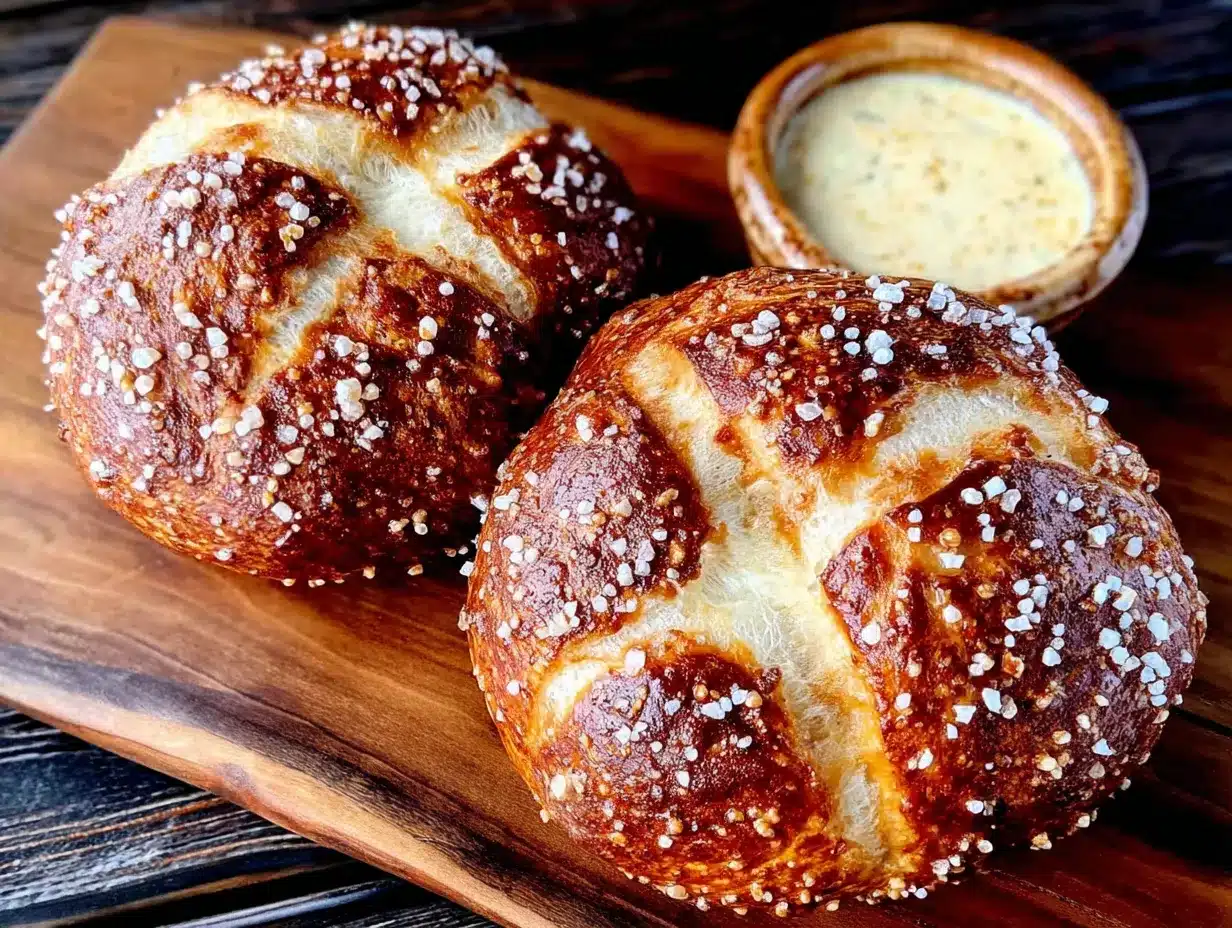
- Finish the tops. Transfer the bathed rolls back to the parchment-lined baking sheet. Use your sharp knife to score an “X” about 1/4 inch deep on the top of each roll. Brush with the egg wash and sprinkle generously with coarse salt.
- Second rise. Let the rolls rest for 20 minutes while your oven preheats to 425°F (220°C). This short rise helps them stay light.
- Bake. Bake for 15-18 minutes, until the rolls are deep golden brown. Rotate the baking sheet halfway through for even browning. The kitchen will smell incredible at this point.
- Make the mustard butter. While the rolls bake, combine the softened butter, whole grain mustard, honey, and a pinch of salt and pepper in a small bowl. Mix until smooth. Taste and adjust — more mustard if you like it punchy, more honey if you want sweetness.
- Cool and serve. Let the rolls cool on a wire rack for at least 10 minutes before serving. They’re best warm, with the mustard butter melting into every crevice. But honestly, they’re pretty great at room temperature too.
Cooking Tips & Techniques
I’ve made plenty of mistakes with pretzel rolls so you don’t have to. Here’s what I’ve learned the hard way.
Don’t skip the baking soda bath. I know it seems fussy, but this step is non-negotiable. The alkaline bath is what gives pretzels their distinctive dark crust and chewy texture. I once tried to skip it and just brush the rolls with baking soda water — they came out pale and bland. Total waste of an afternoon.
Watch your water temperature. This is the most common mistake I see. If your water is too hot (above 130°F), it kills the yeast. Too cold (below 100°F), and the yeast won’t activate properly. I use an instant-read thermometer, but if you don’t have one, the water should feel like a warm bath — comfortable, not hot.
Let the dough rise properly. I know it’s tempting to rush this step, but under-proofed dough makes dense rolls. Your dough should be visibly puffy and hold an indentation when you poke it gently. If it springs back immediately, give it more time.
Score with confidence. When you cut the “X” on top, make it decisive. A shallow, hesitant cut won’t open up during baking. I use a lame (a baker’s razor blade), but a sharp paring knife works fine. Just commit to the cut.
Multitasking tip: While the dough is rising, make your mustard butter and get your baking soda bath ready. It makes the whole process feel smoother. I also like to set out my parchment-lined baking sheet and have my salt ready to go.
Variations & Adaptations
These pretzel rolls are pretty flexible. Here are some ways I’ve adapted them for different needs and cravings.
Gluten-Free Version: I tested this with a 1:1 gluten-free flour blend, and it actually worked pretty well. Use a blend that contains xanthan gum, and add an extra tablespoon of water since gluten-free flours absorb more liquid. The texture won’t be quite as chewy, but the flavor is still spot-on.
Everything Bagel Topping: Instead of coarse salt, sprinkle the rolls with everything bagel seasoning before baking. I do this when I want something a little more savory. The sesame seeds and garlic flakes toast up beautifully in the oven.
Cheese-Stuffed Rolls: Before shaping each roll, flatten the dough into a disc, place a cube of sharp cheddar or gouda in the center, and seal the dough around it. The cheese gets melty and amazing inside. Just make sure the cheese is fully enclosed, or it will leak out during the bath.
Spicy Mustard Butter: Add a pinch of cayenne pepper or a teaspoon of horseradish to the mustard butter for a kick. I tried this last Super Bowl, and it disappeared in minutes.
Serving & Storage Suggestions
These rolls are best served warm, ideally within an hour of baking. The crust is at its crispiest, and the interior is pillowy soft. I like to set them out on a wooden board with a bowl of the mustard butter for spreading. They’re perfect alongside a hearty bowl of soup — I’m partial to a creamy tomato or a beefy chili.
For storage, let the rolls cool completely, then keep them in an airtight container at room temperature for up to 2 days. After that, they start to get a little stale. You can revive them by warming them in a 300°F oven for 5 minutes. The crust crisps back up nicely.
These rolls freeze beautifully. Once they’re completely cool, wrap each one individually in plastic wrap, then place them in a freezer bag. They’ll keep for up to 3 months. To reheat, unwrap and warm in a 350°F oven for 10 minutes, or microwave for 20-30 seconds if you’re in a hurry. The texture won’t be quite as good from the microwave, but it’s fine for a quick fix.
One thing I’ve noticed — the flavors actually develop a bit overnight. The mustard butter gets more mellow and the rolls seem even more flavorful the next day. So don’t be afraid to make them ahead for a party.
Nutritional Information & Benefits
Here’s the thing about these pretzel rolls — they’re lighter than traditional versions, but they’re still a treat. And that’s okay. Food should be enjoyed.
Per roll (without butter): Approximately 180 calories, 3g fat, 32g carbohydrates, 2g fiber, 6g protein. The addition of whole wheat pastry flour adds a bit of fiber and nutrients compared to all-purpose flour. Greek yogurt in the dough provides a small protein boost and keeps the rolls moist without extra butter.
The mustard butter adds about 60 calories per tablespoon. It’s made with real butter, but a little goes a long way. The whole grain mustard adds minimal calories and a nice dose of flavor.
These rolls are vegetarian and can be made dairy-free by using plant-based yogurt and butter. They’re not gluten-free in their standard form, but I’ve included a variation above.
I like that these rolls let me enjoy something I genuinely love without the heavy feeling afterwards. They’re not a health food — they’re a balanced choice that satisfies a craving without going overboard.
Conclusion
These Lighter Bavarian Pretzel Rolls with Easy Mustard Butter are more than just a recipe to me. They’re a connection to a memory, a little piece of my childhood that I can still enjoy in a way that feels good now. Every time I make them, I think of Aunt Peggy’s kitchen and that salty crater I’d leave in every roll. And honestly, I still put a little extra salt on mine sometimes. Some habits are worth keeping.
I hope you give these a try. Don’t stress about making them perfect — the first batch I made was lopsided and a little pale, and they were still delicious. That’s the beauty of homemade food. It doesn’t have to be perfect to be wonderful. Play with the variations, adjust the salt to your liking, and serve them with whatever makes you happy. That’s what cooking should be about.
If you make these rolls, I’d love to hear about it. Drop a comment below and let me know how they turned out, or share your own twist on the recipe. And if you’re looking for something to serve alongside them, my hearty lentil soup is a perfect match. Happy baking, friends.
Frequently Asked Questions
Can I make these pretzel rolls without a stand mixer?
Absolutely. You can knead the dough by hand on a lightly floured surface for about 10 minutes. It takes a little more effort, but the results are just as good. Your arms might get a workout, though!
Why do I need to boil the rolls in baking soda water?
That baking soda bath is what gives pretzel rolls their signature dark, glossy crust and chewy texture. It’s not optional — without it, you’d just have regular bread rolls. The alkaline water changes the chemistry of the dough’s surface, creating that distinctive pretzel character.
Can I use all-purpose flour instead of bread flour?
You can, but the texture will be softer and less chewy. Bread flour has more protein, which creates more gluten and gives pretzel rolls their characteristic bite. If you only have all-purpose, it’ll still work — just expect a slightly different texture.
How do I know when the rolls are fully baked?
Look for a deep golden-brown color on the crust. The internal temperature should reach about 190°F if you’re using a thermometer. They should sound hollow when tapped on the bottom. And honestly, they’ll smell done — that warm, yeasty, pretzel aroma is unmistakable.
Can I double this recipe?
Yes, but you’ll need to work in batches for the baking soda bath. Don’t overcrowd the pot — each roll needs room to cook evenly. The dough doubles easily, and you can freeze any extra rolls for later.
Pin This Recipe!
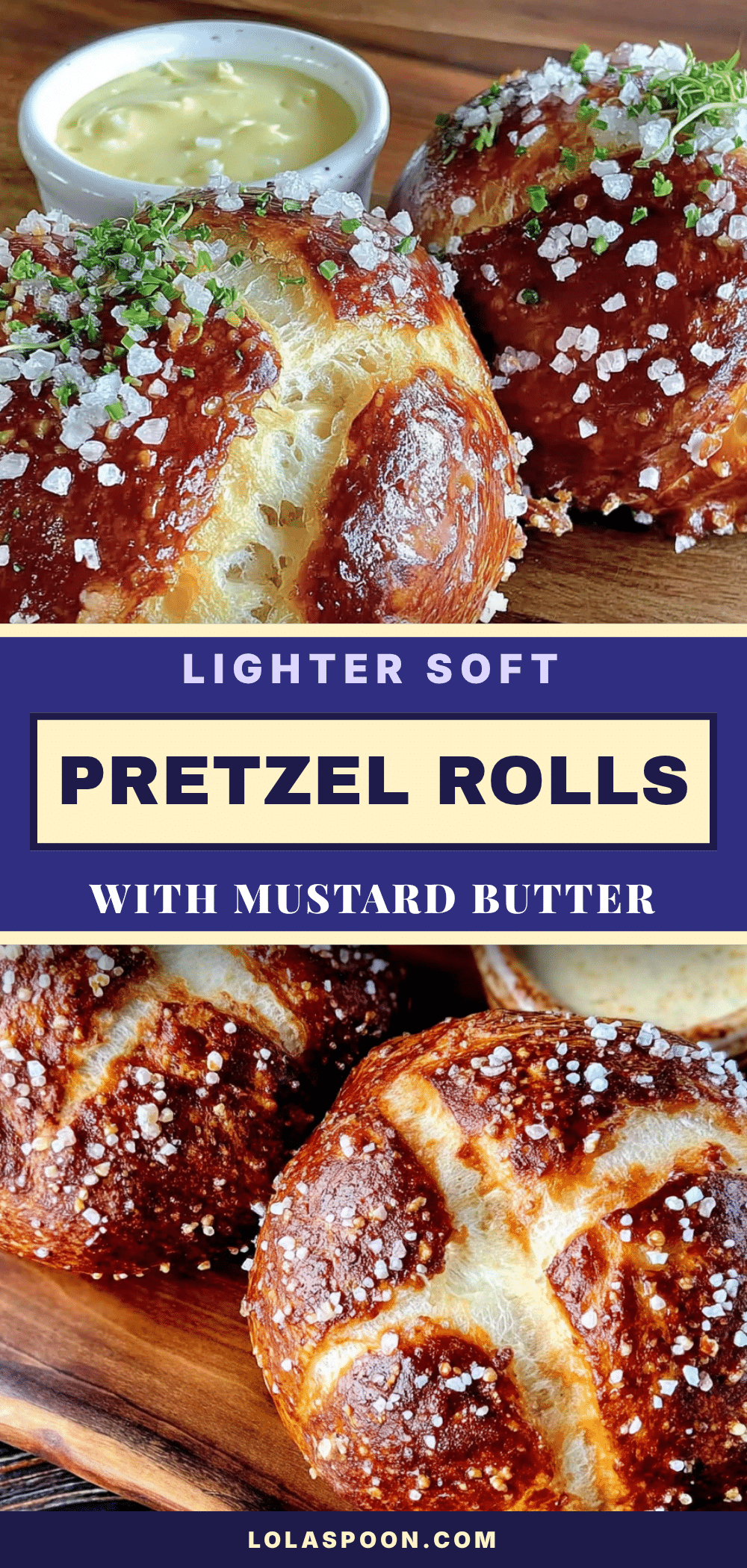
Lighter Bavarian Pretzel Rolls with Easy Mustard Butter

These lighter Bavarian pretzel rolls deliver the same chewy, golden-brown exterior and pillowy soft center as traditional versions, but with smarter swaps like Greek yogurt and whole wheat pastry flour. Paired with a tangy, creamy mustard butter, they’re perfect for game day, cozy dinners, or any time you crave comfort food without the heavy feeling.
- Prep Time: 20 minutes
- Cook Time: 18 minutes
- Total Time: 1 hour 30 minutes
- Yield: 8 servings 1x
- Category: Bread
- Cuisine: German
Ingredients
- 2 cups (240g) bread flour
- 1 cup (120g) whole wheat pastry flour
- 1 packet (2 1/4 teaspoons) active dry yeast
- 1 cup (240ml) warm water (about 110°F)
- 1/4 cup (60g) plain Greek yogurt
- 1 tablespoon honey
- 1 teaspoon salt
- 1 tablespoon unsalted butter, melted
- 8 cups (2 liters) water (for baking soda bath)
- 1/3 cup (80g) baking soda
- 1 tablespoon coarse sea salt or pretzel salt
- 1 egg (for egg wash)
- 1 tablespoon water (for egg wash)
- 4 tablespoons (56g) unsalted butter, softened (for mustard butter)
- 2 tablespoons whole grain mustard
- 1 teaspoon honey (for mustard butter)
- Salt and pepper to taste (for mustard butter)
Instructions
- Activate the yeast: In the bowl of a stand mixer, combine warm water (110°F) and honey. Sprinkle yeast over the top and let sit for 5-7 minutes until foamy.
- Mix the dough: Add bread flour, whole wheat pastry flour, Greek yogurt, salt, and melted butter to the yeast mixture. Use the dough hook on low speed for about 2 minutes until combined.
- Knead the dough: Increase speed to medium and knead for 6-7 minutes until smooth and elastic. Add flour or water as needed.
- First rise: Shape dough into a ball, place in a lightly oiled bowl, cover, and let rise in a warm spot for about 60 minutes until doubled in size.
- Shape the rolls: Punch down dough, divide into 8 equal pieces (about 85g each). Shape each into a ball, place on a parchment-lined baking sheet, cover, and let rest for 15 minutes.
- Prepare baking soda bath: Bring 8 cups of water to a boil in a large pot. Carefully add baking soda (it will bubble vigorously), then reduce heat to a gentle simmer.
- Bathe the rolls: Gently lower each roll into the simmering water using a slotted spoon. Cook for 30 seconds on each side. Work in batches of 2-3.
- Finish the tops: Transfer bathed rolls back to the baking sheet. Score an ‘X’ about 1/4 inch deep on top of each roll. Brush with egg wash (1 egg beaten with 1 tablespoon water) and sprinkle with coarse salt.
- Second rise: Let rolls rest for 20 minutes while preheating oven to 425°F (220°C).
- Bake: Bake for 15-18 minutes until deep golden brown, rotating the sheet halfway through.
- Make mustard butter: While rolls bake, combine softened butter, whole grain mustard, honey, and a pinch of salt and pepper. Mix until smooth.
- Cool and serve: Let rolls cool on a wire rack for at least 10 minutes. Serve warm with mustard butter.
Notes
Don’t skip the baking soda bath—it’s essential for the dark, chewy crust. Use a thermometer for water temperature to ensure yeast activates properly. For best results, let the dough rise fully and score with confidence. Rolls can be frozen for up to 3 months.
Nutrition
- Serving Size: 1 roll
- Calories: 180
- Sugar: 3
- Sodium: 450
- Fat: 3
- Saturated Fat: 1.5
- Carbohydrates: 32
- Fiber: 2
- Protein: 6
Keywords: pretzel rolls, bavarian pretzel rolls, lighter pretzel rolls, mustard butter, homemade pretzel rolls, game day appetizer, easy bread recipe