My accountant, Mr. Henderson, is the last person I’d expect to get baking advice from. The man wears the same gray cardigan every day, communicates mostly in numbers, and once told me that cinnamon was “unnecessarily aromatic.” So when I stopped by his office to drop off some tax documents last October, I wasn’t prepared for what happened. There he was, pulling a golden, fragrant loaf out of a tiny toaster oven in the corner of his cramped office. The smell hit me first — warm yeast, butter, and something floral I couldn’t place. “It’s Pan de Muerto,” he said, wiping flour off his glasses. “My grandmother’s recipe. You should try it.”
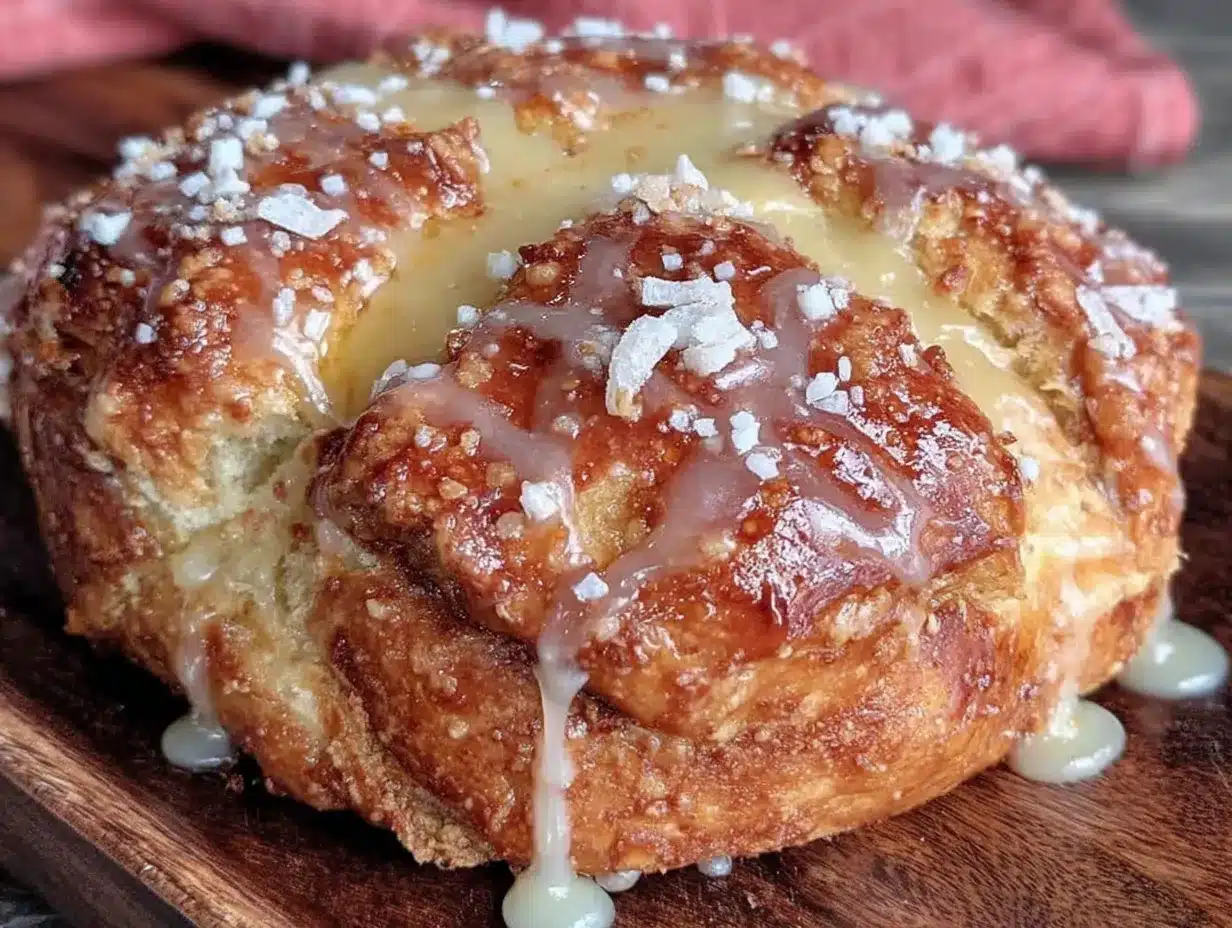
I stood there, completely stunned. This man who filed my quarterly estimates had been secretly making one of the most beautiful breads I’d ever seen. The loaf was round, topped with a cross of dough that looked like bones, and dusted with sugar that sparkled under the fluorescent lights. He cut me a slice, still warm, and handed it over. That first bite was a revelation — soft, pillowy, with a hint of orange that danced on my tongue. I asked him for the recipe right there, and he scribbled it on the back of an invoice. I mean, honestly, where else would you find a recipe like that?
This Best Pan de Muerto with Orange Blossom Glaze has become my go-to for fall gatherings. It’s the kind of bread that stops conversation when you bring it to the table. Maybe you’ve been there — searching for that one dish that feels special without being fussy. This is it. Every time I make it, I think about Mr. Henderson and his grandmother, and how the best recipes come from the most unexpected places. The orange blossom glaze adds this delicate sweetness that makes the bread feel almost magical. Let me tell you, once you try this, you’ll never go back to store-bought bread.
Why You’ll Love This Recipe
I’ve tested this Best Pan de Muerto with Orange Blossom Glaze more times than I can count, and let me tell you, it’s the version I keep coming back to. Here’s why this recipe stands out from the rest:
- Perfect for Hosting: This bread is designed to impress. When you walk into a dinner party carrying a golden, glazed loaf of Pan de Muerto, people notice. It’s a showstopper that requires minimal effort on your part.
- Make-Ahead Friendly: The dough can be prepared the night before, which means you can focus on other dishes while your guests arrive. Just shape and bake the next day.
- Simple Ingredients: No fancy grocery store trips needed. Flour, yeast, eggs, butter, and orange blossom water — you probably have most of these already.
- Crowd-Pleaser: I’ve served this at potlucks, family dinners, and holiday parties. It disappears every single time. Kids love the sweet glaze, and adults appreciate the sophisticated orange flavor.
- Authentic Flavor: This isn’t a shortcut version. The orange blossom glaze adds that traditional floral note that makes Pan de Muerto special. It’s the real deal.
What makes this recipe different? It’s the balance. The dough is soft and enriched with butter and eggs, but it’s not heavy. The orange blossom glaze adds sweetness without being cloying. I’ve tested different ratios of orange zest, orange juice, and orange blossom water until I found the perfect combination. This is the version that makes you close your eyes after the first bite — that moment when everything just works.
This recipe is perfect for Día de Muertos celebrations, fall gatherings, or any time you want to bake something that feels meaningful. It’s comfort food with a story, and honestly, that’s the best kind of food.
What Ingredients You Will Need
This recipe uses simple, wholesome ingredients to create a bread that’s both tender and flavorful. Most of these are pantry staples, but a few specialty items make all the difference. Let me walk you through each one.
For the Dough
- All-purpose flour (4 cups / 500g) — I prefer King Arthur Flour for consistent results. The protein content gives the bread structure while keeping it soft.
- Active dry yeast (2 ¼ teaspoons / 7g) — One packet works perfectly. Make sure it’s fresh — check the expiration date before you start.
- Whole milk (½ cup / 120ml), warmed to 110°F — This activates the yeast and adds richness. You can use 2% milk, but whole milk gives a better texture.
- Granulated sugar (½ cup / 100g) — Just enough to sweeten the dough without making it dessert-like.
- Unsalted butter (½ cup / 113g), softened — I use Kerrygold for its rich flavor. Let it come to room temperature naturally.
- Large eggs (3), room temperature — This is important! Cold eggs can slow down the rising process. Leave them on the counter for 30 minutes.
- Orange zest (2 tablespoons) — From about 2 large oranges. Use a microplane for the best texture. This is where the flavor starts.
- Orange blossom water (1 tablespoon) — Find this in the international aisle or a Middle Eastern grocery store. A little goes a long way.
- Salt (1 teaspoon) — Don’t skip this. Salt controls the yeast and enhances the other flavors.
- Vanilla extract (1 teaspoon) — Pure vanilla, not imitation. It adds warmth to the orange flavor.
For the Orange Blossom Glaze
- Powdered sugar (1 ½ cups / 180g) — Sift it to avoid lumps. Trust me on this.
- Orange blossom water (2 tablespoons) — This is the star. It gives the glaze that floral, aromatic quality.
- Fresh orange juice (2 tablespoons) — From the oranges you zested. Fresh juice makes a difference.
- Unsalted butter (2 tablespoons), melted — Adds richness and helps the glaze set.
For Decoration
- Granulated sugar (¼ cup / 50g) — For dusting the baked bread. It adds that sparkle that makes the bread look professional.
- Orange zest (1 teaspoon) — Optional, but nice for garnish.
When selecting orange blossom water, look for brands like Cortas or Al Wadi. They’re affordable and widely available. The orange blossom water is what makes this Best Pan de Muerto with Orange Blossom Glaze authentic, so don’t substitute it with vanilla or almond extract. You can find it online if your local store doesn’t carry it.
For the butter, I’ve tested this with salted butter and it works in a pinch, but unsalted gives you more control over the salt level. If you only have salted, reduce the added salt to ½ teaspoon.
Equipment Needed
You don’t need a professional bakery setup for this recipe. Here’s what you’ll need:
- Stand mixer with dough hook — This makes kneading much easier. I use my KitchenAid, but any stand mixer works. You can knead by hand, but it takes about 10-12 minutes of elbow grease.
- Large mixing bowl — For rising the dough. Glass or stainless steel works best.
- Baking sheet — A half-sheet pan is perfect. Line it with parchment paper for easy cleanup.
- Microplane or zester — For getting fine orange zest. A box grater works too, but it’s harder to get the texture right.
- Pastry brush — For applying the glaze. A silicone brush is easiest to clean.
- Cooling rack — Essential for letting the bread cool evenly. If you don’t have one, let it cool on the baking sheet for 10 minutes, then transfer to a cutting board.
- Plastic wrap or clean kitchen towel — For covering the dough while it rises.
- Sharp knife or bench scraper — For shaping the dough and cutting the bone shapes.
If you’re on a budget, skip the stand mixer and knead by hand. It’s a great arm workout, honestly. Just make sure you knead until the dough is smooth and elastic — about 10 minutes of consistent work.
Preparation Method
Let me walk you through this step by step. I’ve made this Best Pan de Muerto with Orange Blossom Glaze dozens of times, so I know exactly where things can go wrong. Pay attention to the sensory cues — they’re your best friend.
- Activate the yeast (5 minutes): In a small bowl, combine the warm milk (110°F), 1 tablespoon of sugar, and the yeast. Stir gently and let it sit for 5 minutes until frothy. If it doesn’t foam, your yeast is dead. Start over with fresh yeast.
- Mix the dough (10 minutes): In the bowl of your stand mixer, combine the flour, remaining sugar, salt, and orange zest. Add the yeast mixture, eggs, orange blossom water, and vanilla. Mix on low speed until a shaggy dough forms, about 2 minutes.
- Add the butter (5 minutes): With the mixer running on low, add the softened butter one tablespoon at a time. The dough will look messy — that’s normal. Keep mixing until the butter is fully incorporated and the dough is smooth.
- Knead the dough (8-10 minutes): Increase the speed to medium-low and knead for 8-10 minutes. The dough should be smooth, elastic, and slightly tacky but not sticky. It should pull away from the sides of the bowl. If it’s too sticky, add flour one tablespoon at a time. Too dry? Add milk one teaspoon at a time.
- First rise (1-2 hours): Place the dough in a lightly oiled bowl, cover with plastic wrap, and let it rise in a warm spot until doubled in size. I put mine in the oven with the light on. It should take about 1-2 hours depending on your kitchen temperature.
- Shape the dough (15 minutes): Punch down the dough and turn it onto a lightly floured surface. Divide it into two pieces — one larger piece (about ⅔ of the dough) for the base, and one smaller piece (about ⅓) for the decorations. Shape the large piece into a smooth round ball and place it on the prepared baking sheet.
- Create the bone shapes (10 minutes): Divide the smaller piece into 4 equal parts. Roll each into a rope about 6 inches long. Place two ropes across the top of the loaf to form a cross, and two more ropes to form the “bones” — shape them like small bones by pinching the ends. Press them gently into the dough so they stick.
- Second rise (45 minutes to 1 hour): Cover the shaped loaf loosely with plastic wrap and let it rise again until puffy, about 45 minutes to 1 hour. It should look noticeably larger but not doubled.
- Preheat and bake (25-30 minutes): Preheat your oven to 350°F (175°C). Bake the bread for 25-30 minutes until golden brown and hollow-sounding when tapped on the bottom. The internal temperature should reach 190°F. Let it cool on the baking sheet for 10 minutes, then transfer to a cooling rack.
- Make the glaze (5 minutes): While the bread cools, whisk together the powdered sugar, orange blossom water, orange juice, and melted butter until smooth. The glaze should be thick but pourable. If it’s too thick, add more orange juice a teaspoon at a time.
- Glaze and decorate (5 minutes): Once the bread is completely cool, brush the glaze generously over the top. Let it set for 5 minutes, then sprinkle with granulated sugar and orange zest. The glaze will harden slightly, giving the bread a beautiful sheen.
One thing I learned the hard way — don’t rush the cooling process. If you glaze the bread while it’s still warm, the glaze will melt and run off. Wait until it’s completely cool to room temperature. Trust me, I’ve made that mistake more than once.
Cooking Tips & Techniques
After making this Best Pan de Muerto with Orange Blossom Glaze more times than I care to admit, I’ve picked up a few tricks that make the process smoother. Here are the things I wish someone had told me:
Temperature matters more than you think. Cold ingredients will kill your yeast or slow down the rise. I learned this the hard way when I used cold eggs straight from the fridge and ended up with a dense, sad loaf. Let everything come to room temperature — eggs, milk, butter. Your dough will thank you.
Don’t overthink the shaping. The bone shapes don’t need to be perfect. In fact, slightly imperfect shapes look more authentic. I’ve had loaves where one “bone” was thicker than the others, and honestly, nobody noticed. The rustic look is part of the charm.
Watch the glaze consistency. If your glaze is too thin, it will run off the bread and pool on the baking sheet. If it’s too thick, it won’t spread evenly. Aim for the consistency of thick maple syrup. If you mess up, just add more powdered sugar or more orange juice — it’s forgiving.
Multitask wisely. While the dough is rising for the first time, I prep my glaze ingredients and set out the sugar for decorating. That way, when the bread comes out of the oven, I’m ready to go. It saves time and keeps me from rushing.
Common mistake — overproofing. If you let the dough rise too long during the second rise, it will collapse in the oven. The loaf should look puffy but still hold its shape. When you gently press it with your finger, it should spring back slowly. If it doesn’t spring back at all, you’ve gone too far.
Variations & Adaptations
One of the best things about this recipe is how adaptable it is. Here are some variations I’ve tried and loved:
Gluten-Free Version: I tested this with a 1:1 gluten-free flour blend, and it worked surprisingly well. The texture was slightly denser, but the flavor was still there. Add an extra tablespoon of milk to compensate for the drier flour. My friend Sarah, who has celiac, said it was the best gluten-free bread she’d had in years.
Dairy-Free Adaptation: Swap the butter with vegan butter (I like Miyoko’s) and use oat milk instead of whole milk. The glaze can be made with coconut oil instead of butter. The flavor changes slightly, but the orange blossom still shines through.
Flavor Twist — Chocolate Orange: Add ¼ cup of cocoa powder to the flour mixture and increase the sugar by 2 tablespoons. The chocolate and orange combination is incredible. I made this for a Halloween party, and it was gone in 20 minutes.
Seasonal Variation — Pumpkin Spice: Replace the orange zest with pumpkin pie spice (1 tablespoon) and add ½ cup of pumpkin puree to the dough. Reduce the milk by ¼ cup since the pumpkin adds moisture. This version is perfect for Thanksgiving.
Less Sweet Version: Reduce the sugar in the dough to ¼ cup and skip the glaze entirely. Brush the baked bread with melted butter and dust with cinnamon sugar instead. It’s still delicious, just less dessert-like.
I’ve also tried adding dried cranberries or chopped pecans to the dough for texture. Both work well, but the traditional version without add-ins is still my favorite. There’s something pure about the plain bread with that orange blossom glaze.
Serving & Storage Suggestions
This Best Pan de Muerto with Orange Blossom Glaze is best served at room temperature, but warm is also wonderful. If you want to serve it warm, pop it in a 300°F oven for 5-7 minutes before serving. The glaze will soften slightly, and the bread will smell amazing.
For a dinner party, I like to serve this bread alongside a spread of other dishes. It pairs beautifully with:
- Hot chocolate or coffee — The orange blossom flavor complements the bitterness of coffee perfectly.
- Fresh fruit — Sliced apples or pears balance the sweetness.
- Mexican hot chocolate — The cinnamon and chocolate notes are a natural match.
- Vanilla ice cream — For an extra indulgent dessert option.
When it comes to presentation, I place the bread on a wooden board or a colorful ceramic plate. The golden glaze and sugar crystals catch the light beautifully. If you’re hosting a Día de Muertos celebration, add marigolds or sugar skulls around the bread for a festive touch.
Storage: Store the bread in an airtight container at room temperature for up to 3 days. Do not refrigerate — it will dry out the bread. The glaze stays shiny for about 24 hours, then it will start to soften. That’s normal.
Freezing: You can freeze the unglazed bread for up to 3 months. Wrap it tightly in plastic wrap and then foil. When you’re ready to serve, thaw it at room temperature, then reheat in a 300°F oven for 10 minutes. Glaze it after reheating. The flavor actually improves after freezing — the orange zest seems to deepen.
Reheating: For individual slices, microwave for 10-15 seconds. For the whole loaf, wrap in foil and heat in a 300°F oven for 10 minutes. The bread will come out soft and fragrant, just like fresh-baked.
One thing I love about this bread is that the flavors develop over time. Day-old Pan de Muerto is actually better for some things — the orange blossom flavor becomes more pronounced. I’ve been known to save a slice for the next morning just to enjoy it with my coffee.
Nutritional Information & Benefits
Here’s a rough estimate for one serving (1/8 of the loaf with glaze):
- Calories: 320
- Fat: 12g
- Carbohydrates: 48g
- Protein: 6g
- Fiber: 1g
- Sugar: 22g
This bread is a treat, so I don’t pretend it’s health food. But it does have some redeeming qualities. The eggs provide protein and healthy fats. The orange zest is packed with vitamin C and antioxidants. And honestly, there’s something to be said for the mental health benefits of baking — the process itself is therapeutic.
For those with dietary concerns, this recipe contains gluten, dairy, and eggs. It’s not suitable for vegans or those with celiac disease without modifications. The gluten-free version I mentioned earlier works well for those avoiding wheat.
I like to think of this bread as a celebration food. It’s not something you eat every day, but when you do, it’s worth every bite. The orange blossom glaze adds a touch of elegance that makes the bread feel special without being overly indulgent.
Conclusion
This Best Pan de Muerto with Orange Blossom Glaze has become a fall tradition in my house. Every time I make it, I think about Mr. Henderson and his grandmother, and how the best recipes come from the most unexpected places. It’s the kind of bread that makes you slow down and appreciate the moment — the smell of orange blossom filling the kitchen, the warmth of the bread in your hands, the sparkle of sugar on the glaze.
I hope you give this recipe a try. Don’t worry if your bone shapes aren’t perfect or if the glaze drips a little. The beauty of this bread is in its imperfection. It’s meant to be shared, enjoyed, and remembered. Whether you’re celebrating Día de Muertos, hosting a fall dinner party, or just want to bake something that feels special, this bread delivers.
If you make it, I’d love to hear how it turns out. Leave a comment below and let me know if you tried any variations or if you have your own family traditions around Pan de Muerto. And if you’re looking for more fall baking inspiration, check out my pumpkin bread recipe or my apple cider donuts — both are perfect for cozy autumn mornings.
Happy baking, friends. And remember — the best recipes are the ones that come with a story.
Frequently Asked Questions
Can I make this bread ahead of time?
Absolutely! You can prepare the dough through the first rise, then refrigerate it overnight. The next day, let it come to room temperature for about 30 minutes, then shape and proceed with the recipe. The flavor actually improves with the longer, slower rise.
What if I can’t find orange blossom water?
You can substitute with 1 tablespoon of orange juice and 1 teaspoon of orange extract. The flavor won’t be exactly the same, but it will still be delicious. Look for orange blossom water in the international aisle of your grocery store or online.
Why did my bread turn out dense?
This usually happens for one of three reasons: your yeast was dead, you didn’t knead enough, or you didn’t let it rise long enough. Make sure your yeast is fresh and your kitchen is warm enough for rising. The dough should be smooth and elastic before the first rise.
Can I freeze the glazed bread?
I don’t recommend freezing glazed bread because the glaze can become sticky and lose its shine. Freeze the unglazed bread instead, then thaw and glaze it fresh. It’s worth the extra step!
How do I know when the bread is fully baked?
The bread should be golden brown on top and sound hollow when you tap the bottom. If you have an instant-read thermometer, the internal temperature should be 190°F. When in doubt, bake it an extra 2-3 minutes — underbaked bread is worse than slightly overbaked bread.
Pin This Recipe!
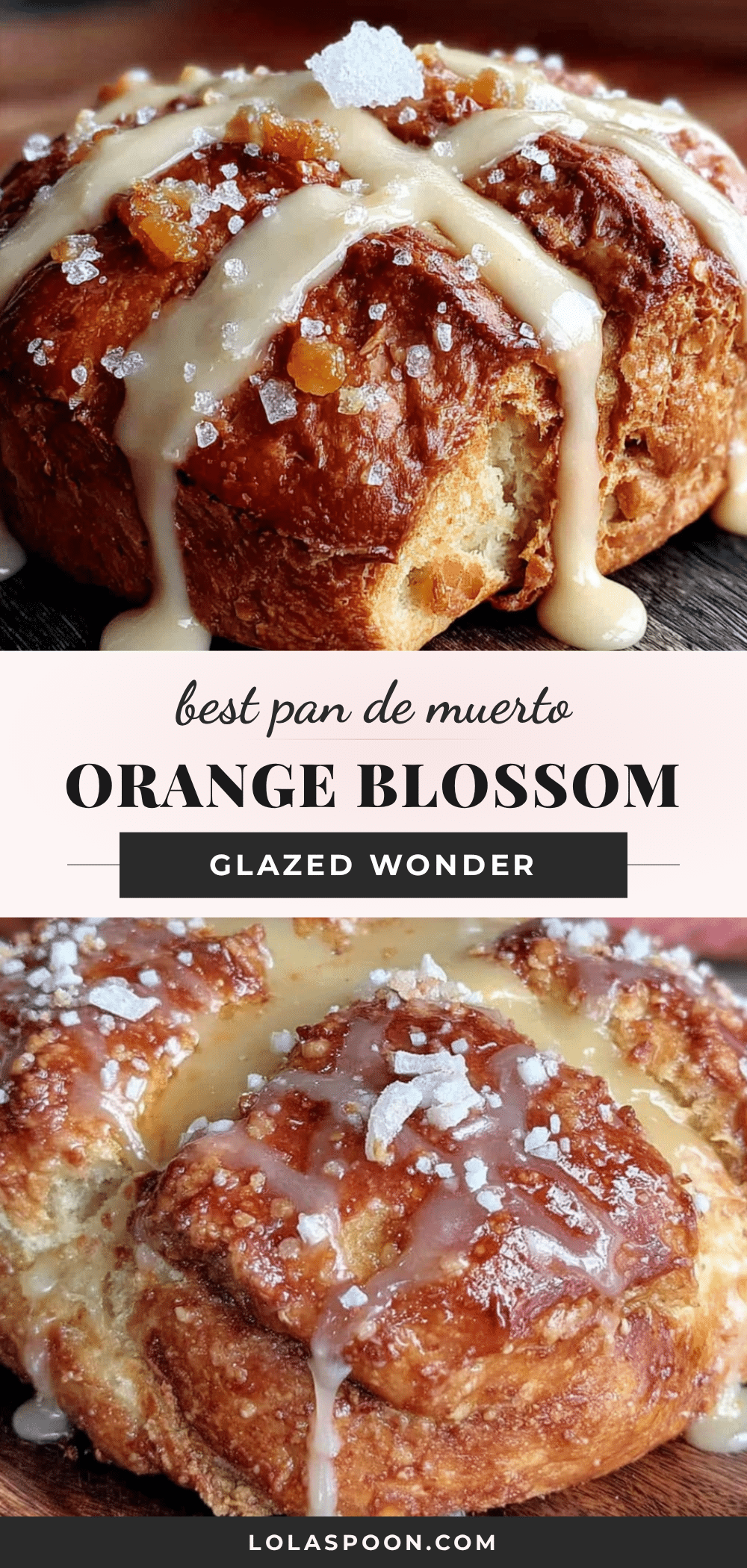
Best Pan de Muerto with Orange Blossom Glaze
A soft, pillowy bread with a delicate orange blossom glaze, perfect for fall gatherings and Día de Muertos celebrations. This recipe comes from an unexpected source—an accountant’s grandmother—and delivers authentic flavor with simple ingredients.
- Prep Time: 30 minutes
- Cook Time: 25-30 minutes
- Total Time: 2 hours 30 minutes to 3 hours 30 minutes
- Yield: 8 servings 1x
- Category: Bread
- Cuisine: Mexican
Ingredients
- 4 cups (500g) all-purpose flour
- 2 ¼ teaspoons (7g) active dry yeast
- ½ cup (120ml) whole milk, warmed to 110°F
- ½ cup (100g) granulated sugar
- ½ cup (113g) unsalted butter, softened
- 3 large eggs, room temperature
- 2 tablespoons orange zest
- 1 tablespoon orange blossom water
- 1 teaspoon salt
- 1 teaspoon vanilla extract
- 1 ½ cups (180g) powdered sugar
- 2 tablespoons orange blossom water (for glaze)
- 2 tablespoons fresh orange juice
- 2 tablespoons unsalted butter, melted (for glaze)
- ¼ cup (50g) granulated sugar (for decoration)
- 1 teaspoon orange zest (optional, for garnish)
Instructions
- Activate the yeast: In a small bowl, combine warm milk (110°F), 1 tablespoon sugar, and yeast. Stir gently and let sit for 5 minutes until frothy.
- Mix the dough: In a stand mixer bowl, combine flour, remaining sugar, salt, and orange zest. Add yeast mixture, eggs, orange blossom water, and vanilla. Mix on low speed until a shaggy dough forms, about 2 minutes.
- Add the butter: With mixer on low, add softened butter one tablespoon at a time. Mix until fully incorporated and dough is smooth.
- Knead the dough: Increase speed to medium-low and knead for 8-10 minutes until smooth, elastic, and slightly tacky. Add flour or milk as needed.
- First rise: Place dough in a lightly oiled bowl, cover with plastic wrap, and let rise in a warm spot until doubled in size, about 1-2 hours.
- Shape the dough: Punch down dough and turn onto a floured surface. Divide into two pieces—⅔ for the base, ⅓ for decorations. Shape the large piece into a smooth round ball and place on a parchment-lined baking sheet.
- Create bone shapes: Divide the smaller piece into 4 equal parts. Roll each into a 6-inch rope. Place two ropes across the top to form a cross, and two more to form bones. Press gently into the dough.
- Second rise: Cover shaped loaf loosely with plastic wrap and let rise until puffy, about 45 minutes to 1 hour.
- Preheat and bake: Preheat oven to 350°F (175°C). Bake for 25-30 minutes until golden brown and hollow-sounding when tapped. Internal temperature should reach 190°F. Cool on baking sheet for 10 minutes, then transfer to a cooling rack.
- Make the glaze: Whisk together powdered sugar, orange blossom water, orange juice, and melted butter until smooth and thick but pourable.
- Glaze and decorate: Once bread is completely cool, brush glaze generously over the top. Let set for 5 minutes, then sprinkle with granulated sugar and orange zest.
Notes
Don’t rush the cooling process—glaze only when bread is completely cool to prevent melting. The bone shapes don’t need to be perfect; rustic looks authentic. For best results, let all ingredients come to room temperature before starting.
Nutrition
- Serving Size: 1 slice (1/8 of loaf
- Calories: 320
- Sugar: 22
- Sodium: 200
- Fat: 12
- Saturated Fat: 7
- Carbohydrates: 48
- Fiber: 1
- Protein: 6
Keywords: Pan de Muerto, orange blossom, Día de Muertos, Mexican bread, fall baking, holiday bread, orange glaze